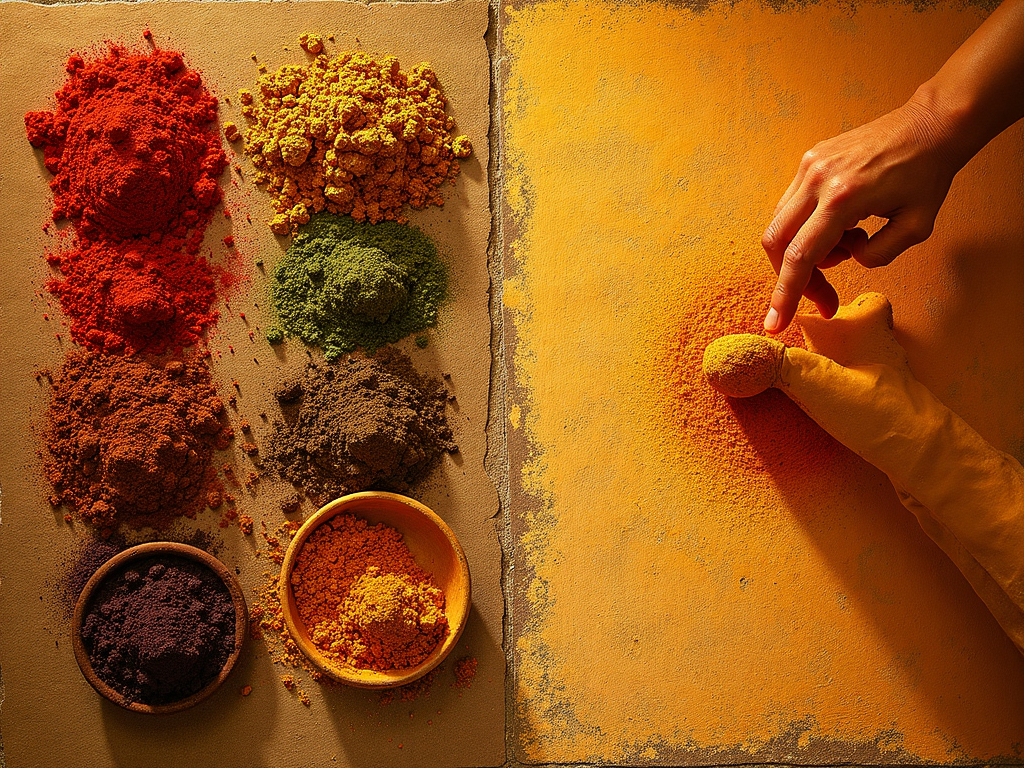
Pigments in Roman, Medieval, and Renaissance Art
1. Roman Pigments (Pompeii, 3rd Century BCE – 79 CE)
The frescoes of Pompeii showcase a vibrant palette, primarily using natural pigments extracted from minerals and organic materials, with Egyptian Blue as the only synthetic pigment. Techniques included fresco (pigments applied on wet plaster) and encaustic (wax-based painting).
| Color | Pigment | Chemical Composition | Origin | Techniques and Notes | Physical Production |
|---|---|---|---|---|---|
| Red | Pompeian Red (Iron Oxide) | Fe₂O₃ (hematite) | Natural Mineral | Iconic for vibrant backgrounds, stable. Used in frescoes. | Extracted from hematite-rich rocks, ground and purified. |
| Red | Cinnabar | HgS (mercury sulfide) | Natural Mineral | Expensive, used for high-end details. Darkens with light exposure. | Mined, crushed, and finely ground. |
| Red | Minium | Pb₃O₄ (lead oxide) | Natural / Treated Mineral | Bright, used for details. Toxic. | Produced by heating lead or grinding natural lead oxide. |
| Yellow | Yellow Ochre | FeO(OH)·nH₂O (limonite) | Natural Mineral | Affordable and stable, used for backgrounds. | Collected, ground, and washed. |
| Yellow | Orpiment | As₂S₃ (arsenic trisulfide) | Natural Mineral | Bright but highly toxic. | Mined and carefully ground. |
| Blue | Egyptian Blue | CaCuSi₄O₁₀ (cuprorivaite) | Synthetic | Expensive, used for refined details. Only synthetic pigment. | Heated silica, copper, calcium, and natron at 800–900°C. |
| Blue | Azurite | Cu₃(CO₃)₂(OH)₂ | Natural Mineral | Affordable, may turn green over time. | Mined and finely ground. |
| Green | Malachite | Cu₂CO₃(OH)₂ | Natural Mineral | Used for landscapes, bright tone. | Mined and ground into powder. |
| Green | Green Earth | Fe, Mg, Al, K silicates | Natural Mineral | Muted tones, often in landscapes. | Collected, ground, and washed. |
| White | Lime White | CaCO₃ (calcium carbonate) | Natural Mineral | Base for frescoes and light details. | Calcined limestone, ground. |
| White | Lead White | 2PbCO₃·Pb(OH)₂ | Treated Mineral | Opaque, used for highlights. Toxic. | Oxidized lead with vinegar and CO₂, then ground. |
| Black | Carbon Black | C (amorphous carbon) | Organic | Used for outlines and backgrounds. | Produced by burning wood, bones, or resins. |
2. Medieval Pigments (5th–15th Century)
Medieval art, including manuscript illumination, frescoes, and altarpieces, relied on natural and a few synthetic pigments. Techniques included egg tempera and fresco. Production methods are described in treatises such as Cennino Cennini’s Il Libro dell’Arte.
| Color | Pigment | Chemical Composition | Origin | Techniques and Notes | Physical Production |
|---|---|---|---|---|---|
| Red | Cinnabar / Vermilion | HgS | Natural / Synthetic | Used for details and miniatures. Synthetic vermilion developed later. | Mined cinnabar or produced by heating mercury and sulfur. |
| Red | Madder Lake | Alizarin (C₁₄H₈O₄) | Vegetable | Used for miniatures and textiles. | Extracted from Rubia tinctorum roots, precipitated with alum. |
| Yellow | Yellow Ochre | FeO(OH)·nH₂O | Natural Mineral | Stable, widely used. | Collected, ground, and washed. |
| Yellow | Lead-Tin Yellow | Pb₂SnO₄ | Synthetic | Bright, introduced late in the Middle Ages. | Heated lead and tin oxides. |
| Blue | Ultramarine | Lazurite (Na₈–₁₀Al₆Si₆O₂₄S₂–₄) | Natural Mineral | Very expensive, used for sacred details. | Ground lapis lazuli, purified with resin. |
| Blue | Azurite | Cu₃(CO₃)₂(OH)₂ | Natural Mineral | Common, but unstable (turns green). | Mined and ground. |
| Green | Malachite | Cu₂CO₃(OH)₂ | Natural Mineral | Bright green tones. | Mined and ground. |
| Green | Verdigris | Cu(CH₃COO)₂·nH₂O | Synthetic | Used in miniatures, unstable. | Produced by exposing copper to vinegar and air. |
| White | Lime White | CaCO₃ | Natural Mineral | Base for frescoes. | Calcined limestone, ground. |
| White | Lead White | 2PbCO₃·Pb(OH)₂ | Treated Mineral | Opaque, used in miniatures. Toxic. | Produced with vinegar and CO₂ on lead plates. |
3. Renaissance Pigments (15th–16th Century)
The Renaissance introduced oil painting, enabling richer shades and transparency. Synthetic pigments such as Naples Yellow and Smalt became more common, reflecting advancements in chemical knowledge.
| Color | Pigment | Chemical Composition | Origin | Techniques and Notes | Physical Production |
|---|---|---|---|---|---|
| Red | Vermilion | HgS | Synthetic | Bright, used in clothing and details. | Produced by heating mercury and sulfur. |
| Red | Madder Lake | Alizarin | Vegetable | Warm shades in oil painting. | Extracted from roots, precipitated with alum. |
| Yellow | Lead-Tin Yellow | Pb₂SnO₄ | Synthetic | Luminous details. | Heated lead and tin oxides. |
| Yellow | Naples Yellow | Pb(SbO₃)₂ | Synthetic | Toxic, but highly valued. | Made by heating lead and antimony. |
| Blue | Ultramarine | Lazurite | Natural Mineral | Expensive, used for skies and sacred robes. | Ground and purified lapis lazuli. |
| Blue | Smalt | Cobalt glass | Synthetic | Used in oils for bright tones. | Ground cobalt-colored glass. |
| Green | Verdigris | Copper acetates | Synthetic | Used for transparent glazes, unstable. | Scraped patina from copper exposed to vinegar. |
| White | Lead White | 2PbCO₃·Pb(OH)₂ | Synthetic | Essential in oil painting. Toxic. | Made via corrosion of lead with vinegar and CO₂. |
Comparison Across Periods
- Roman (Pompeii): Mostly natural pigments, with Egyptian Blue as the only synthetic.
- Medieval: Introduction of synthetic vermilion and verdigris; artisanal production.
- Renaissance: Oil painting enabled new techniques, and synthetic pigments like Naples Yellow and Smalt became standard.
References
- Berrie, Barbara H., ed. Artists’ Pigments: A Handbook of Their History and Characteristics. 4 vols. Washington, D.C.: National Gallery of Art, 1986–2007. Link
- Eastaugh, Nicholas, Valentine Walsh, Tracey Chaplin, and Ruth Siddall. Pigment Compendium: A Dictionary of Historical Pigments. London: Routledge, 2008.
- Cennini, Cennino. The Craftsman’s Handbook (Il Libro dell’Arte). Translated by Daniel V. Thompson Jr. New York: Dover Publications, 1960. Full Text
- Theophilus Presbyter. On Divers Arts. Translated by John G. Hawthorne and Cyril Stanley Smith. New York: Dover Publications, 1963. Full Text
- Vitruvius. Ten Books on Architecture. Translated by Ingrid D. Rowland. Cambridge: Cambridge University Press, 1999. Selections Online
- Kirby, Jo, Marika Spring, and Catherine Higgitt. Natural Colorants for Dyeing and Lake Pigments. London: Archetype Publications, 2014.
- National Gallery, London. “Pigments and Painting Techniques.” National Gallery Technical Bulletin. Link
- The Getty Conservation Institute. “Art and Archaeology Technical Abstracts.” getty.edu
- Victoria & Albert Museum. “Pigments and Dyes in the Collection.” vam.ac.uk
Notes on Italian Earth Pigments, Natural Greens and Blues — Procedures & References
The following describes the principal Italian earth pigments (siennas, umbers, green earth) and the most relevant natural green/blue materials used in Italian workshops, with practical production procedures (how pigments were prepared) and short notes on stability and use.
| Pigment / Variant | Typical Composition | Uses | Physical production / Preparation | Notes on behavior & stability |
|---|---|---|---|---|
| Raw Sienna (Terra di Siena, raw) | Hydrated iron oxide + clay ± Mn oxides | Underpainting, warm shadows, glazing base in fresco/tempera/oil | Quarry or dig earth → remove large impurities → wash/levigate in water to separate fines → dry → grind to fine powder → sieve. For paint, mix with binder (lime for fresco, egg for tempera, oil for oil). | Stable, transparent; good for glazing. Often used as a mid-tone rather than pure color. |
| Burnt Sienna (Terra di Siena, burnt) | Dehydrated iron oxides (darker, more red) from raw sienna | Warm shadows, glazes, modeling in oil | Prepare raw sienna as above → calcine/heating in a controlled kiln (or hearth) until color deepens → cool → regrind to a fine powder → sieve. (Temperature and time control produce tone variations.) | More intense and warmer than raw sienna; highly valued for transparent glazing layers. |
| Raw Umber (Terra d’Ombra, raw) | Iron oxides + manganese oxides + clay | Shadows, underlayers, earth tones in fresco/tempera/oil | Quarry earth → dry → grind → wash/levigate to remove coarser particles → dry → grind fine. Used directly in binder. | Cool brown; good covering power and fast drying in oil mixtures (when combined with lead whites/mediums). |
| Burnt Umber | Thermally altered umber; richer iron oxide tones | Warm shadows, glazing, chiaroscuro | Same production as raw umber, with a controlled firing step (kiln roast) to alter chroma → cool → regrind to powder. | Warmer and deeper than raw umber; excellent for glazing and tonal modeling. |
| Green Earth / Verona Green (Terra Verde, verdaccio base) | Glauconite, celadonite, other Fe-Mg-Al silicates | Verdaccio underpainting for flesh, muted greens in fresco and tempera | Mine clay-like rock → crush → levigate (wash in water repeatedly to separate fine particles) → dry → grind → sieve. Often mixed with a small proportion of carbon black + white to create verdaccio underlayer. | Very stable and lightfast; muted tone good for underpainting. Not as bright as malachite or verdigris. |
| Malachite (natural green) | Cu₂CO₃(OH)₂ (basic copper carbonate) | Brighter greens in panels and frescos (less common in fresco due to sensitivity) | Extract from malachite ore → crush into coarse fragments → grind in a mortar and pestle or milling apparatus with water → levigate to remove coarser particles → dry → grind to fine powder. In tempera/oil, often mixed with a binding medium; in fresco, instability limited its use. | Brilliant but can react in some media; can darken/alter with sulfur-containing environments. More vivid than green earth but less stable than earths. |
| Azurite (natural blue) | Cu₃(CO₃)₂(OH)₂ (basic copper carbonate) | Blue backgrounds, skies, mixes with other pigments (may green over time) | Crush ore → grind in water → levigate to separate particle sizes → dry → fine grinding. Sometimes gently roasted to alter tone (careful: can degrade). In oil, used as is; in tempera, bound with egg. | May alter to green (malachite-like) under certain conditions (presence of moisture, acids). Particle size affects hue and opacity. |
| Ultramarine (lapis lazuli → natural ultramarine) | Primary component: lazurite (complex Na–Al–Si–S mineral) | Highly prized blue for robes, skies, sacred imagery | Imported lapis lazuli (Afghanistan) → crush coarse rock → repeatedly grind and separate impurities using a series of washes, kneading with resin/wax/alkaline solutions (historical recipes vary) to isolate the finest blue lazurite grains → multiple purifications and washings → dry → sieve → very fine grinding. Venetian and Florentine workshops had specific purification steps to obtain the deep ultramarine. | Extremely costly but very stable and lightfast. Purity of separation determines brilliance. |
| Smalt (cobalt glass) | Potassium glass + cobalt oxide (K–Si–Co matrix) | Blue tint in oil painting, cheaper alternative to ultramarine | Fuse silica (sand), potash (or natron), and cobalt oxide at high temperature → form colored glass → cool → crush and grind to powder → levigate to appropriate particle size → use as pigment (often with lead white or oil binder). | Color can fade as the glass matrix becomes decolorized over time; particle size strongly affects hue and opacity. |
| Verdigris (copper acetate) | Cu(CH₃COO)₂·nH₂O (copper acetates) | Brilliant green for miniature work and glazes | Expose copper (sheets, filings) to acetic fumes (vinegar, wine) in sealed chambers or bury copper in fermenting organic matter → scrape formed green patina → collect → dry → grind to pigment. Historical recipes often recommend combining with wax/resin or oil to stabilize. | Very brilliant but chemically reactive and can darken or bleed in some media; requires careful stabilization and use in glazes rather than as opaque paint. |
Practical Notes for Workshop Use
- Levigation (wet washing) was a core step: repeatedly suspending crushed pigment in water and decanting finer particles yields cleaner, more uniform color and removes grit.
- Heating / calcining (for siennas & umbros) must be controlled: excessive heat can alter chemical structure and reduce pigment quality, while insufficient heat yields weaker tone changes.
- Particle size controls opacity and hue: finer particles → more transparent and brighter glazes; coarser → more opaque and duller tones.
- Stabilization for reactive pigments (verdigris, some copper greens): binders, wax/resin additions, or use in glazes recommended to reduce chemical reactivity with air/humidity.
Selected English-language References (accessible)
- CAMEO Materials Database — “Sienna” (Museum of Fine Arts, Boston)
- ColourLex — “Raw Sienna”
- WebExhibits — “Umber”
- Getty Conservation Institute — Conservation Resources
- Victoria & Albert Museum — Collections & Pigment Resources
- National Gallery (London) — Technical Research & Publications
- Eastaugh, N., V. Walsh, T. Chaplin & R. Siddall. Pigment Compendium. Routledge, 2008. (See entries for sienna, umber, green earth, azurite, malachite, ultramarine, smalt.)
Warning: Many historical pigments (lead-based whites, cinnabar/vermillion, orpiment, some copper compounds) are toxic. The procedural descriptions above are historical/technical summaries and not instructions for unsupervised synthesis. Handle with professional guidance and correct safety precautions.
 SgtrAiArt