Hey everyone,
It’s been a while, I know. But as it often happens, life gets in the way… and let’s be honest, sometimes it’s hard to fight our own neurons 😊.
I wanted to take a moment to talk about something that I believe is going to be crucial—especially for those of us looking to get the most out of this incredible paradigm we call Artificial Intelligence.
As most of you already know, AI can do some truly amazing things—especially in the world of art. This summer, here in the northern hemisphere, we’ve seen something huge: the arrival of the first true video-generation models (or rather, model-based functions). This is a real milestone for the field.
As expected, the big companies—those with deep pockets—have launched some real gems (or maybe just shiny traps, as we half-boomer, half-gen-X types like to say here in Italy). And of course, the business model follows suit: premium subscriptions for advanced features are now hovering around the same ballpark—let’s say $80–$100/month, just to keep up the illusion of competition.
Naturally, we’re not even counting the big players like Google and OpenAI, who are already charging over $200/month. And wouldn’t you know it—those are the very platforms offering the most comprehensive AI features: images, video clips, time-based frame generation, lip-syncing, motion control, and so on. In short, exactly the tools you need 😊.
On top of that, creating a high-quality video product often requires at least two platforms working together—whether cloud-based or something else entirely. So if you want to be at the top of your game (which, let’s face it, we all hope to be), you’re looking at a monthly spend of somewhere between $250 and $500.
But here’s the upside: the current market seems to be leaving space for those willing to roll up their sleeves and build their own tools. Even if it means stepping out of their comfort zone or diving into unfamiliar territory, some creators are managing to reach their goals by developing custom, software-oriented solutions that replicate the most sought-after features.
We see this reflected in the pricing of API services—some of which are made available to developers. It’s as if the companies are saying: “If you can do it yourself, go for it—you’ll save money too.” Honestly, that’s not a bad thing. It didn’t have to be that way.
But let’s not forget: none of this comes free. There’s always a cost behind the scenes—someone has to pay the bill. Nothing in this world is truly free.
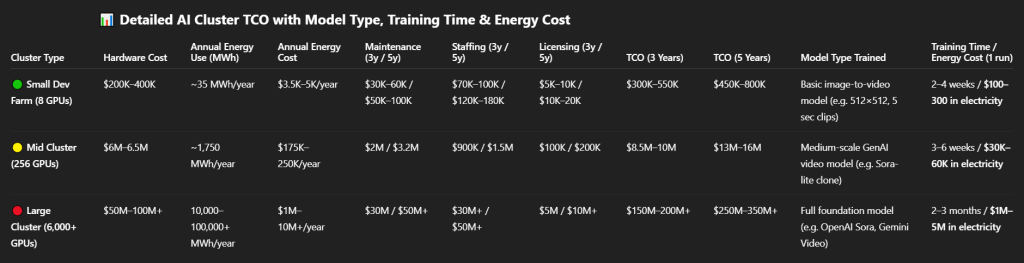
Example: cluster farm estimate + 1 model run (Made with ChatGPT Free – for illustrative purposes only)
Business is business.
Don’t blame companies for chasing their business goals. Everyone answers to someone higher up the food chain—they’re just doing their jobs.
Greed is a personal trait, not necessarily something that spreads across an entire organization. Still, human nature tends to “drift”—and let’s be honest, we live in a world where money still rules everything. There’s no real alternative to it. Utopias are nice, but they rarely pay the bills.
Some people—those rare few—really are exceptions. Modern-day Don Quixotes who keep fighting windmills (I’m one of them). But most businesspeople will squeeze what they can out of every opportunity—it’s kind of a corporate survival instinct.
If you’re lucky, someone might recognize your artistic value and actually invest in you. That means you won’t just be eating crumbs—you might get a bite of the apple too.
Note: People are often misunderstood, but only time reveals the truth. Genuine philanthropists are rare and often dismissed, especially when the economy’s in the dumps. Why that is—I still don’t know 😊.
And what about creators?
Creators who are tuned into what’s happening are starting to realize that not everything that glitters is gold.
It’s going to be tough to lean on “the community” in a broad sense, for all the reasons I just mentioned. But still, hope is a good thing to hold onto.
Maybe now’s the time to internalize what we’ve learned over the past few years:
- Keep learning and exploring new tech—it will pay off.
- Challenge yourself across different platforms and tools—your knowledge is a valuable asset.
- Don’t limit AI to art alone; use the experience to develop skills that can be applied elsewhere, especially on the technical side.
- Real, original art still holds universal value—and it’s marketable.
- Use your early adopter knowledge to improve your personal workflows and buy back your time. Free time is money.
- Art, when reused globally, becomes a product with huge added value. That’s what business wants a piece of 😊.
So, I say this: do what you want—just keep a few things in mind:
- You need an income to live. Artistic production can be a bonus on top of a stable job. Don’t quit a reliable gig for a dream—unless that dream starts turning into a steady income (ask me how I know… I learned the hard way).
- Keep your head up and your spine straight—follow your own path.
- Focus on what’s real. Less dreaming, more building.
- Cut out toxic people. They’re just not worth your time or energy.
- Sometimes, you’ve got to tell someone off—just to remind yourself you’re free (only when necessary, and after thinking it through).
- With time, you’ll learn who’s messing with you and who’s legit. Who’s a true virtual friend, and who’s just using you.
To my dear virtual friends (even if we haven’t met), the ones with bright minds or dark energy, digital ghosts just recently discovered, or pilots of yellow aircraft from early alphabet letters—I say this: becoming fully aware of everything helps unlock a creative process that’s truly free. Maybe that’s the most important thing. If the rest is good, it’ll follow naturally.
In Italy, we’ve got a saying: “Think the worst, and you’re probably right.” I’d add—take that with a grain of salt, and always look for the exceptions.
Note: Writing a good prompt, fixing flow logic in an app, connecting apps to agents, inventing anything that works on any platform (especially the big ones), installing software on non-Windows systems, running local models, learning new tech concepts, storytelling, framing, producing stylized images or video, understanding what LoRA or fine-tuning even means…That’s already a new kind of job.
In case no one told you. Big hugs,
A.S.
 SgtrAiArt